There is something wonderfully familiar about paper.
We encounter it every day—in magazines, newspapers, books, advertisements, packaging, and printed pages that eventually find their way into recycling bins. But for artist Marilyn McRae, paper is far more than something to read, write on, or discard. It is a material filled with possibility.
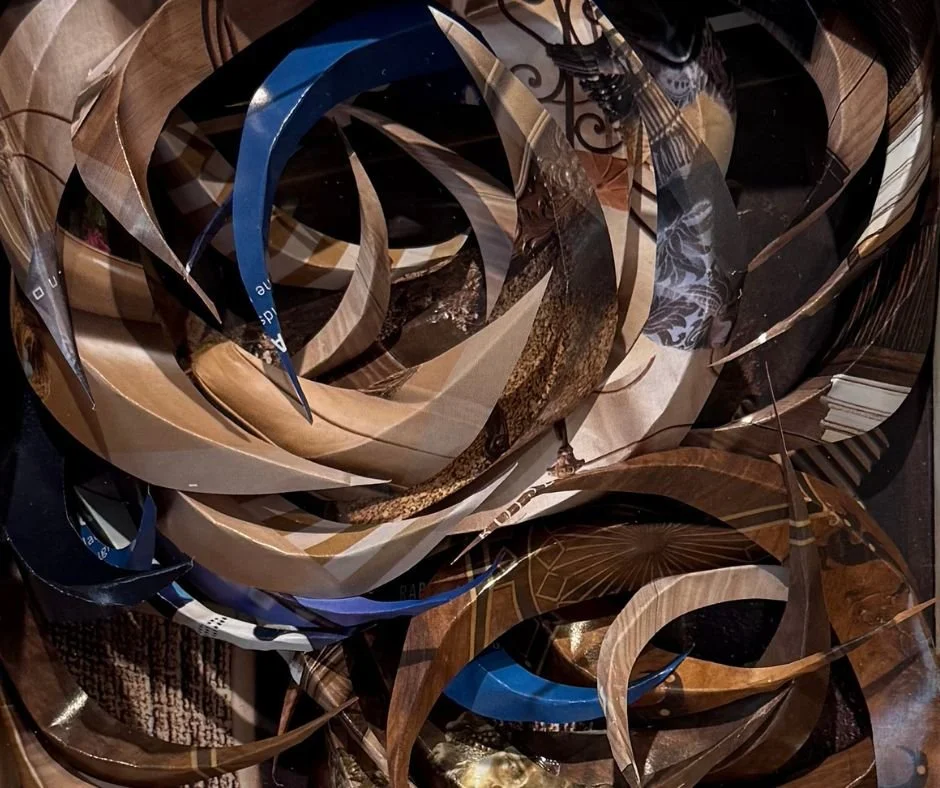
Through tearing, folding, rolling, curling, layering, and sculpting, Marilyn transforms recycled paper into dimensional works that invite us to look at familiar forms in an entirely new way.
Seeing Possibility in the Ordinary
Marilyn's process begins with an idea, but the paper often has a voice of its own.
A printed photograph might become part of a curve. A line of text can emerge unexpectedly from a folded form. A magazine page may be torn into fragments, rolled into delicate tubes, or shaped into a sweeping ribbon. Rather than hiding the origins of the material, Marilyn allows traces of its previous life to remain visible.
The result is a fascinating tension between the recognizable and the reimagined.
A familiar object may suggest a flower, a wave, a landscape, a shell, or an organic structure—but the closer you look, the more you discover that what appears natural has been carefully constructed from something as simple as a sheet of recycled paper.
From Flat Pages to Sculptural Form
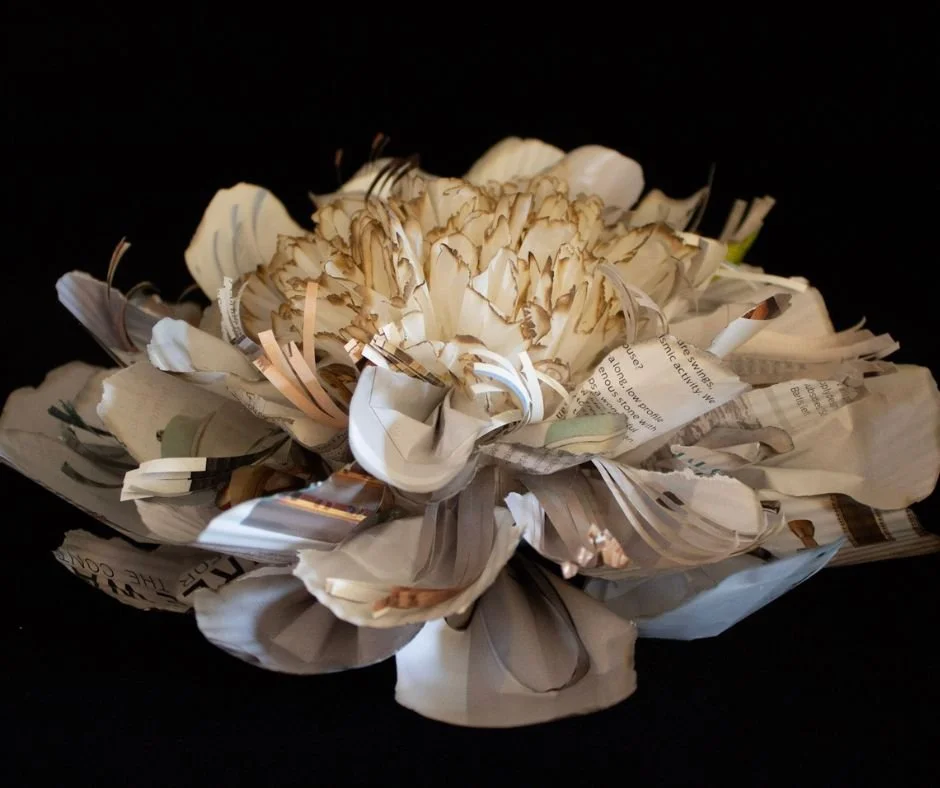
White Peony, by Marilyn McRae.
Paper begins as a flat surface.
Marilyn challenges that expectation.
By manipulating individual strips and pages, she creates volume, movement, texture, and depth. Hundreds of small pieces can come together to form a single flowing composition. Rolled paper creates rhythm and repetition, while folded and curved strips introduce movement and dimension.
In works such as her sculptural floral forms, paper becomes almost botanical. Petal-like shapes overlap and unfold, creating the impression of a flower in bloom. Elsewhere, tightly folded and curled pieces form intricate surfaces that feel almost geological or architectural.
The transformation is remarkable: flat paper becomes form, and form becomes expression.
The Beauty of Imperfection
One of the most compelling aspects of Marilyn's work is that the paper never completely disappears.
Edges remain torn. Printed words peek through. Colors shift from one fragment to another. The natural variation of recycled pages becomes part of the visual language.
These imperfections are not flaws. They are evidence of the process.
Each strip carries its own history, and when those individual pieces are brought together, they create something that could not exist in quite the same way twice.
There is an intimacy in that process. What might have been overlooked as ordinary becomes meaningful through attention and transformation.
Reimagining Nature Through Paper
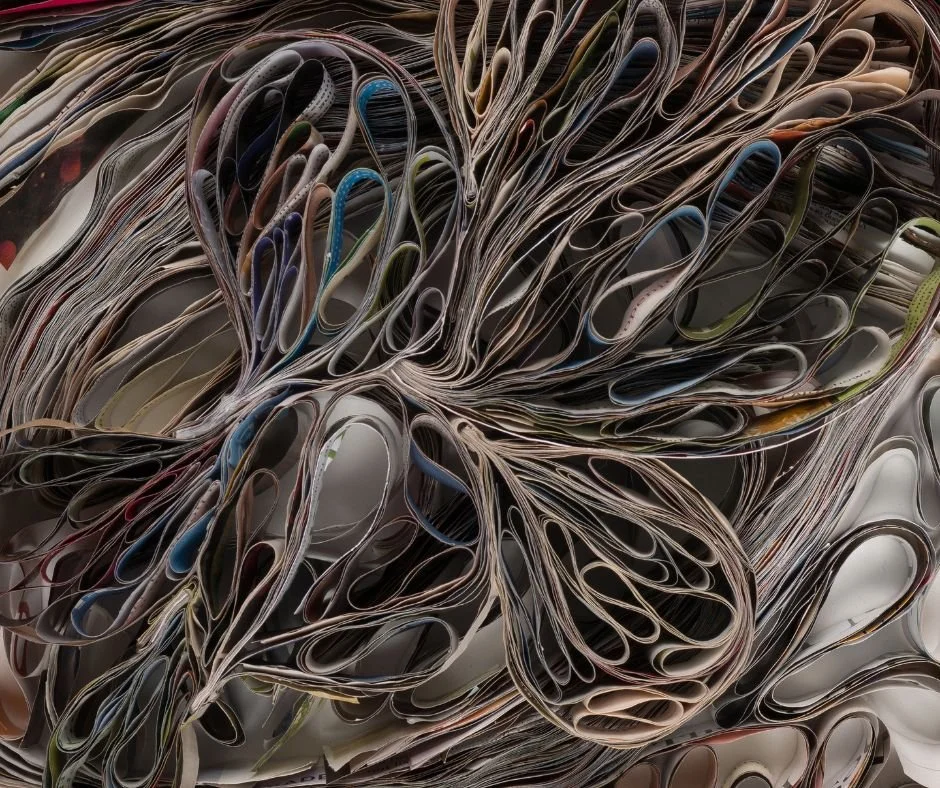
Oceanic Pods, sweeping soaked recycled magazine pages sculpted by Marilyn McRae.
Nature is a recurring influence in Marilyn's work, but she does not simply reproduce what she sees.
Instead, she interprets it.
The sweeping movement of a wave can become a series of curved paper forms. The structure of a flower can inspire layers of torn and curled pages. Branches, foliage, pods, shells, and other organic shapes can emerge through repetition, rhythm, and texture.
In this way, Marilyn's work sits somewhere between observation and imagination.
The viewer may recognize something familiar, but the material continually reminds us that we are looking at a new interpretation—one created entirely from paper.
The Artistry Is in the Transformation
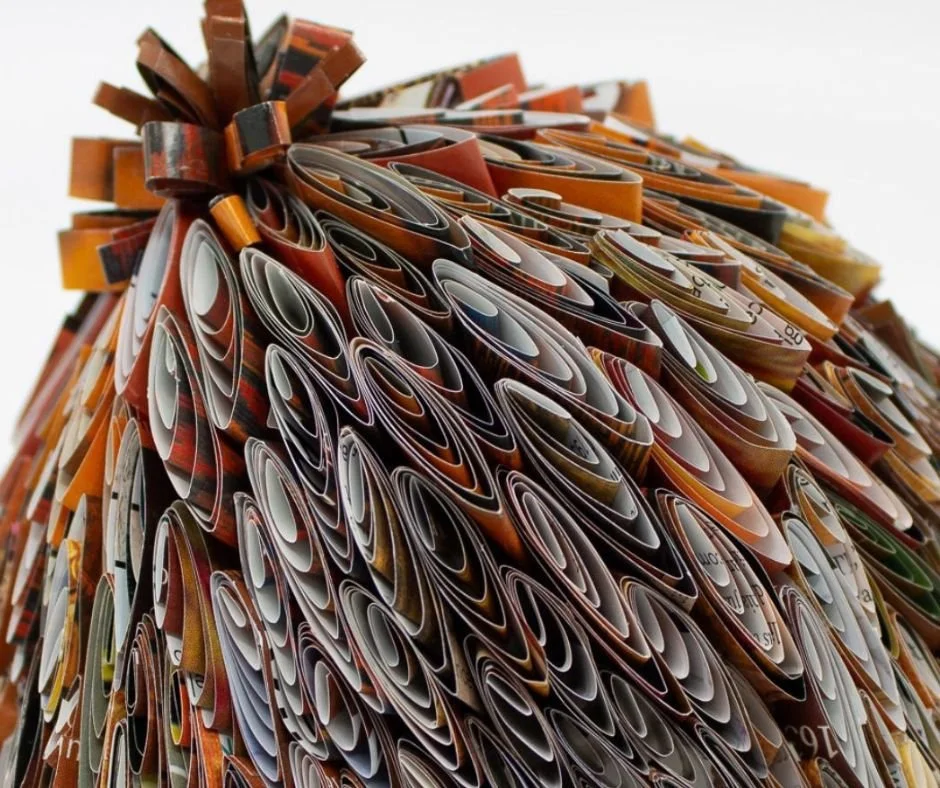
Top Knot, folded and layered to create a sculpted form.
What makes Marilyn McRae's work compelling is not simply the fact that it is made from recycled paper. It is the extraordinary amount of thought, patience, and craftsmanship involved in transforming that paper.
Every curl has to be considered.
Every layer affects the next.
Every piece contributes to the balance of the whole.
What may initially appear spontaneous is often the result of an intricate process of arranging, adjusting, layering, and refining. The finished artwork invites the viewer to see the accumulated decisions—the thousands of small gestures that turn ordinary material into an original work of art.
Looking at Paper Differently
Perhaps the greatest invitation in Marilyn's work is simply to look again.
To look at a magazine page and see color rather than content.
To see a torn edge as texture.
To see a strip of paper as a line.
To see a rolled page as a curve.
To see hundreds of individual pieces come together as a landscape, a flower, a wave, or an entirely imagined form.
Her work reminds us that creativity does not always require rare or precious materials. Sometimes the most interesting possibilities are hiding in the things we already have around us.
Paper can be torn, folded, curled, layered, and transformed—but in Marilyn McRae's hands, it can also be reimagined.
And that is where the artistry begins.